Unit II: Prepping for Argument
IN THIS LESSON
Agenda
Quill post-test could go here (for those still in Quill)
Style: Grammar formula practice (a formula matching the Frazier sentence examined Ian Frazier: start reading)
Frazier: teacher model analysis of one sentence/analyze paradigmatically and syntactically
Do the worksheets on syntax. (These worksheets on syntax and diction are embedded in a larger narrative unit pdf that houses other options for style analysi). Also, here’s another option for reviewing/teaching on syntax.
Discuss the purpose of the piece. How does the model sentence support the purpose of the piece (a principle of style analysis—whole/part).
Have them write a paragraph on a doc, on the purpose of the piece (as an intro to the style analysis).
ML 6 workshop
Homework
Quill
Finish definition paragraph
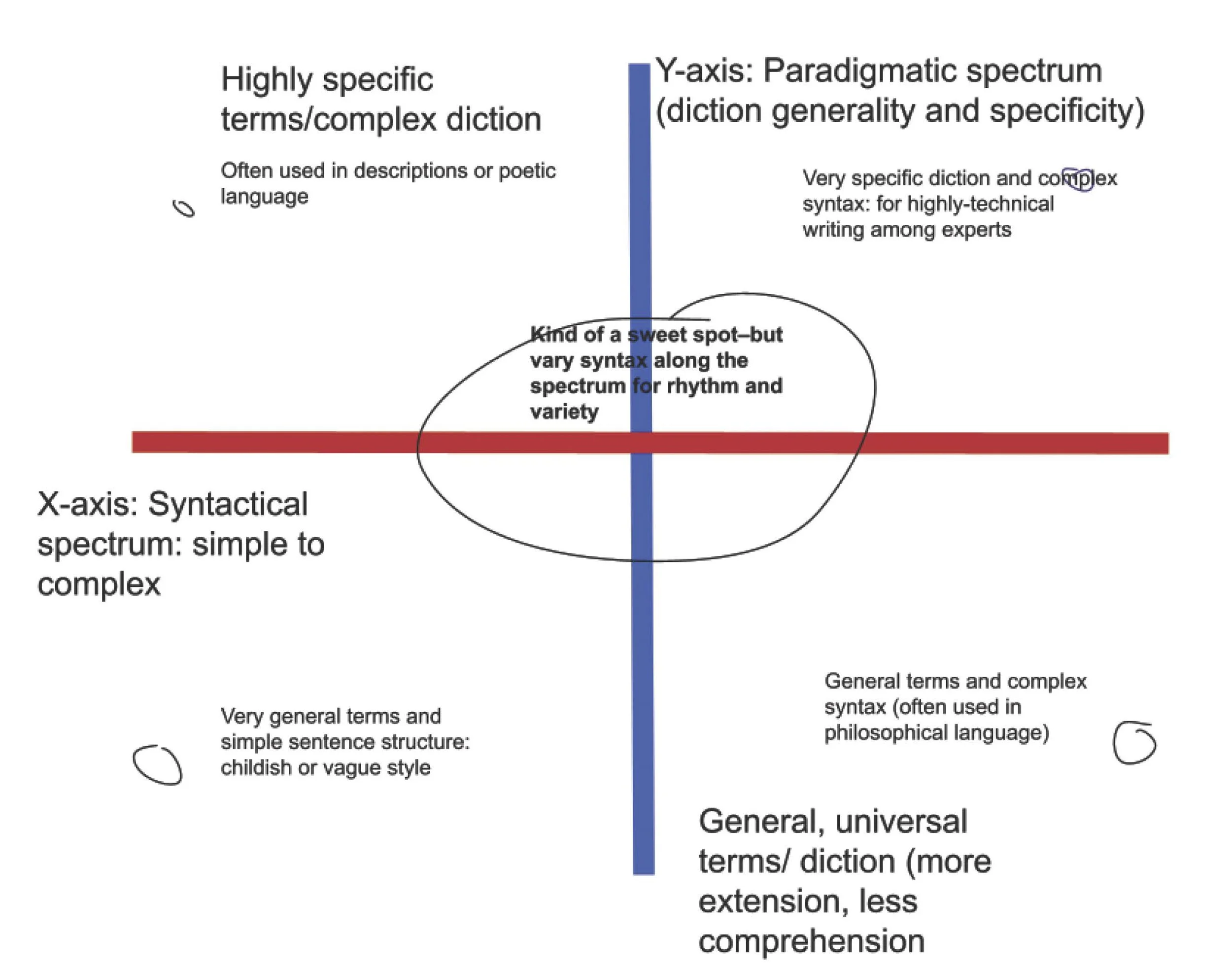
Notes
Grammar: More ideas for grammar/rhetorical device practice/teaching:
Examples: Your own sentence, unpack; examples of logical language (conjunctions and ordering); ordering kernel sentences, sentence expansion and combinations (surfacing propositions and kernel sentence combining).
pick out cumulative sentences and especially vivid examples of diction in light of the overall purpose of the piece
Introduce the periodic sentence
Frazier:
For the Frazier: read together or teacher read. They should annotate for places where they see beautiful language or vivid language that seems especially important. Discuss the purpose of the piece; why it was written. This is essential, because they MUST analyse the style choices in light of the purpose. How does this or that sentence, or choice, support the purpose? They can have slightly different answers for the purpose: the point is that they need to, in their style analysis introduction, explain the purpose and the major clues in the writing as to why they think that is the case. The overall purpose, which they can know immediately, is to define (so it fits in nicely with our studies on basic argument and material logic). What is he defining? Why?
One of the principles of style analysis, just like style analysis for art works, drama, etc, is that the elements must be analysed in light of the whole; ie, what is the purpose, or fundamental assertion/statement? Frazier’s piece is a “profile” of Brooklyn, a part/whole definition, but it is much more than that. Every definition is an assertion, not the least by what it claims as the “essence” of the thing defined (the goal of every good definition as we learn in material logic).
What does Frazier include as “the parts” making up “the whole”? What do you think he might be leaving out? Does he use analogous elements like a microcosm to make his point? Look at the movement of the piece, starting from a bird’s eye view—or more specifically, the view from a plane landing at La Guardia—and ending at Frazier’s apartment building in a poignant narrative…what does this tell you about the purpose or assertion?
You can also ask questions about the piece that incorporate their new understanding of the three acts of the mind (Lesson 3 in the Material Logic text). For example, Frazier does a kind of “apprehension walk” through Brooklyn; the main device in the text is the multiplication of details at a fast, vivid, and concrete pace. He also makes affirmations, of course (second act of the mind)—a more sophisticated way to look at this is by discerning that Frazier affirms (brings in) certain details and leaves others out (a way of non-affirmation or negation). We talk about how an author’s choice of detail and basic affirmations also points to the purpose of the piece. Third, the act of reasoning. I give them an example of “seeing” the third act of the mind in a piece:
Frazier starts with a statement, “ Brooklyn has the undefined shape of a stain.” From the perspectives of grammar and logic, we can see that this is a very basic affirmation, a Subject+Action Verb + Direct Object. He is “linking,” though, in a sense, Brooklyn to “shape,” which is a concept that indicates in logic a quality, or a descriptive such as “curved, square, round” (shape as a quality, not a substance). He also uses the phrase “of a stain” which, in another way, is an accident—literally, “oops”—something stained something else.
He then multiplies the “accidentals,” which could indicate support for the first premise, or definition, which is that Brooklyn has no discernable identity or definition. Here’s a possible syllogism:
Most people want to live in a place that has an identity.
Brooklyn has no identity.
Therefore, most people would not want to live in Brooklyn, or “Who would want to live in Brooklyn?”
This is a common perception about Brooklyn…crowded, dirty, a hodge-podge…getting lost…
However, as Frazier multiplies the details, the “accidentals” of Brooklyn, a new argument is building. By the time we reach the apartment building narrative at the end, Frazier has, through syntax and diction, created a subtle impression of real identity. The apartment complex could be seen as a microcosm of the whole borough, a place of “accidental neighbours” who nevertheless form a community built on love and care for each other, a familiarity created through the diversity, not despite it.
The syntax analysis should reflect this purpose, this fundamental argument (or the important theme or argument discovered by students…these will be variations on the same theme).
Also, here is a chance, as they finish up the Material Logic quiz (on basic terms and judgments), and the Frazier style analysis (syntax and diction), to help them connect to the importance of apprehension/concept/terms/definitions/diction choices, along with the way these concepts are related in judgement and syntax (style is the result of a logical ordering of basic judgments in more complex syntax, as well as the terms we use).
An effective style is always made in light of the purpose for which one is writing (this is a fundamental, precursory understanding of the rhetorical situation).
During this Frazier process where I’m doing some workshopping with individuals and small groups, I’m also talking about paragraph unity and coherence, and transitions between paragraphs to create a line of reasoning (raising awareness).