Unit II: Prepping for Argument
IN THIS LESSON
Agenda
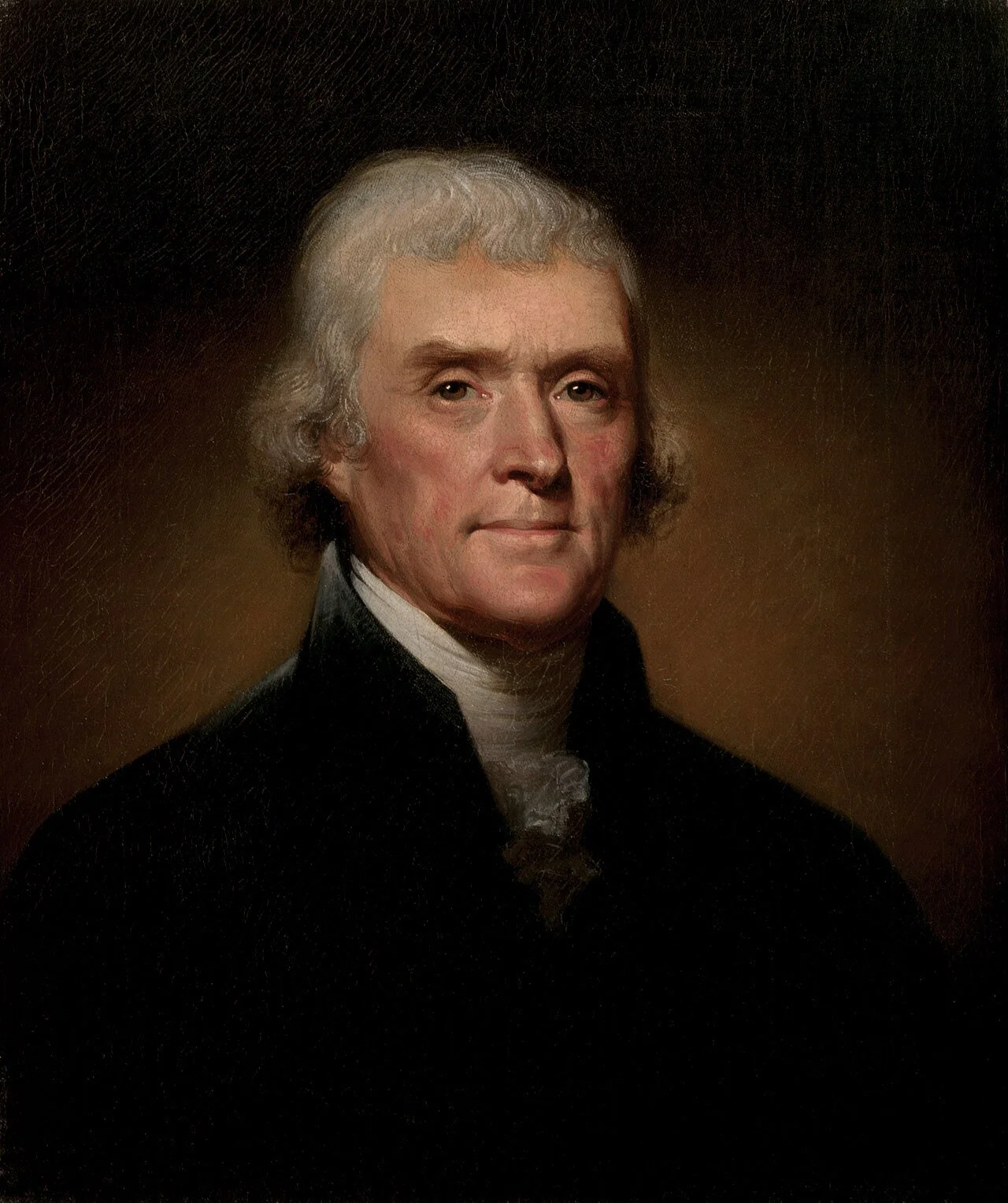
Practicing Grammar/Style: Thomas Jefferson compound sentence: “In matters of style, go with the current; in matters of principle, stand like a rock.” Compound structure with parallel elements creating logic. Discuss.
Grammar: compound and complex and conjunctions III—complex
Could introduce rhetorical devices sheet here in prep for Frazier
Material Logic Review Lessons 1-4 (we could do a pop-quiz on 1-3)
Introduce TOI: Definition
Homework
Quill
finish up Material Logic 4
Notes
1. Grammar/ Style: Since we’ve worked through compound structure and ways to connect them (with logical thinking) with punctuation and/or conjunctions (coordinating conjunctions and conjunctive adverbs), bringing in a sentence by a great stylist and logician (Jefferson) is a great exercise.
I have green sheets with one part of the sentence and red sheets with one part of the sentence; I divide the class by the colour sheet each person has, and ask each colour group to discuss the meaning of their little “sentence.” You will often find that they get an effect of “hardness” from the “principle” clause and a sense of weakness or softness from the “style” clause. You ask them to bring their red sheet together with a person in the class who has a green sheet: what “feeling” or effect does the sentence have when together? What things do they notice about the sentence? Does each part balance the other in terms of content and effect?
I will then put the whole sentence on the board and have them analyse it in small groups for structure and what makes it “sing.”
Three questions for the groups to work on:
What is the syntax? Any patterns beyond basic structure? (Hint: does anything look familiar–from the last class?)
Do you like any of Jefferson’s syntactical choices? Do you dislike any of them?
Talk about the content: What is he saying? Do you agree or disagree?
Hard question for glory: How do the syntax choices relate to the content, the meaning? Does the syntax support, illuminate, extend, contradict the meaning? In other words, why does Jefferson CHOOSE this structure and obvious repetition?
After they discuss, we share answers. Hint: the balance of the syntax is mirroring the content Jefferson is trying to communicate: A balanced person, one who is prudent, one with common sense, will know when to stand ground and when to give way.
Then, to make sure students understand how magical these structures are, they will also be tasked with writing a sentence with different content yet built on the same syntax and mechanics. We’ll read these out.
I then draw their attention to the fact that STYLE HAS CONTENT—they should be seeing it now. I use other arts like fashion or visual or film art to compare…we know in these areas that style is communicating something. I also draw their attention to the importance of knowing the fundamentals of grammar for style analysis—because we know the structure and terms, we can discern deeper purpose and artistry in language, AND we can articulate those insights.
Next, I’ll work on the complex sentence: two independent clauses taken and at least one subordinated logically through the use of a subordinating conjunction or relative pronoun.
They can talk about simple sentence structure, complex/compound, and you can introduce the cumulative sentence structure, which Frazier uses…it is a simple structure completed either in the beginning or the end, and then the modifying phrases (unbound) build up. Here’s an example:
The firecracker went off, sparks flying, each lifting up lazily into the sky, the sound reverberating off the walls like a thousand whips cracking, each cutting through the air, through my head, throwing me to the ground.
They know quite a few rhetorical devices already (literary devices), so encourage them to draw on previous knowledge. They will, for homework, read the piece again and draw out three powerful sentences or use of punctuation, or metaphor, etc.. You’ll be going over these in the next class.
They will write a full style analysis at the end of this section, but you’ll be going over it with them for the poetry/style section of class. :
Intro: purpose of piece, thesis about definition and two major style choices used to support/effect this definition.
First paragraph: First example, analysis (what is the quote and what tools are being used) and then synthesis (how this piece supports the thesis/definition as a whole)
Second paragraph: same, second example.
Conclusion: Why these two pieces of evidence/tools were the most important for the definition you chose, and why you think Frazier chose to create this definition.
Three/Five Fundamental Sentences:
Being verb sentences: Substance (noun) affirmed or denied (judgment).
Linking verb sentences (categorical statements defining or qualifying)
PN: Linking subject (noun) to a categorical predicate (noun) (judgment/proposition; potentially the beginning of categorical syllogism)
PA: Linking subject (noun) to a qualifying or specifying predicate, indicating quality or even property (judgment/proposition, often a minor premise of a categorical syllogism).
Action verb sentences: Substance (noun) and accident (“doing”) *”to have” is a special kind of action called “stative”---it is also one of the categories.
Transitive Action: “goes out into the world” and therefore has a direct and mb indirect object
Intransitive Action: The action is within the subject (*”to have” is sort of in between transitive and intransitive; it most often has a direct object, but it is also mostly about the subject).
I explain that these three (or five) are like the primary colours in colour theory: we use these basic sentences and 1) “decorate them” (specify substances with their accidents), and 2) combine them to form compound or complex sentences.
In this sense, grammar is quite simple. However, like in colour usage, there are many, many options to choose from, many ways to specify and many ways to combine these basic propositions. This combining of propositions and specification IS the art of style—and if you show them that conjunctions (tools for combining) are expressing logical relationships (conclusions, contradictions, equality, etc), this will help them become conscious of how to craft sentences that are not just “correct” but are also clear because they are logical.
When doing the Jefferson sentence, I highlight this art as exemplified in this balanced sentence.
2. Rhetorical Devices/ Prep for Frazier: (this essay will be introduced during Lesson 15): The rhetorical devices sheet is a resource for students, and I encourage them to understand and use the terms “trope” and “scheme” and the different rhetorical devices, as it helps them learn the beauty and power of language effects, and preps them for both the upcoming “Frazier” essay (their first style analysis, helping them appreciate the reason for mastering grammar and rhetorical language). You can introduce this and find examples now, or let the students study the sheet with a quiz, or have them taking notes when you eventually start going over the Frazier essay with them. Frazier’s essay is technically a type of definition (segue to our first Topic of Invention below) and we are focused in logic on definition (words, terms, apprehension, etc).
3. Material Logic Review: By this point, they should understand that THE criterion for both thought and communication is REALITY, and they should have understood the justification for this (how we generate concepts; the first act of the mind). They should also understand the “weight of words”---that words are the symbolic medium for the sharing in reality, and so definition is the foundation for good argument and communication; they should also understand, via grammar, that sentence structure reflects reality (how reality is organised—categories—and how we structure language categorically as well.
4. TOI: Definition: This topic should be almost like a confirmation of all we’ve been doing, but you’ll be stretching them into some ideas that will be covered in logic, Lesson 10. Have students start a section in their class notes titled “Topics of Invention” and explain that these will be tools they will use to create lines of reasoning in arguments and to see lines of reasoning (logos) in rhetorical analysis.
See the Corbett Classical Rhetoric for the Modern Student packet for explanation of this topic.
Definition: genus/species; whole/part; stipulation.
If you can find other examples, these are always good for students. I just pull examples from real life, and sometimes from excerpts, or when I see them in any texts we’re reading. Frazier, in “Take the F,” uses all three types, but mainly via part–to–whole, he builds a definition of Brooklyn. Is it just stipulation, because it is his experience, or can we relate to these experiences as common human ones, and so share in his definition?